Saturday, August 6, 2011

The Politics of Ghanaian News Media
By William Yaw Owusu, Charles Takyi-Boadu, Jamila Akweley Okertchiri &Isaac Osei
This is the first of a two-part series DAILY GUIDE is publishing to explore ethics, objectivity and politics in Ghanaian news media. Next week, the paper talks to practitioners.

One morning on Ring Road, Frank Tubua Okuadjo stopped at a newspaper stand and scanned the headlines. As a young, educated Ghanaian, he thinks about media objectivity and considers it important.

“I don’t want it to be political,” he said.


He pointed to various titles on the stand and ticked them off as supporters of different parties. Partisanship in the press is obvious, he said.

Kofi Hanson, another reader at the stand, agreed.

“The Daily Graphic writes more about things of the government than any other things,” he said. “Some of the papers talk for the government, and others talk for the other parties. Every paper tries to make a good image of their parties. Generally, I like the papers to write something that concerns the nation, not the other parties.”

Press freedom is enshrined in international law, as well as in Ghana’s constitution. Nationally, the media has established a code of ethics by which to conduct itself. The Ghana Journalists Association Code of Ethics behooves media to deliver fair and unbiased news to readers like Hanson and Okuadjo.

Ownership and accountability

There’s a general consensus that most media houses in Ghana are owned by politicians or former politicians, and the perception is that journalists who work for these outlets are often required to tow the political line.

Fred Oware, first national vice chairman of the NPP, has one foot in the political arena, and the other in media, as owner of Choice FM.

“It may very well be that a lot of the media houses either are owned or affiliated one way through the ownership structure with some political parties,” he said. “I do not contest that. But to make a general statement that the people who work there are either coerced, influenced or expected – that might be a perception that people easily lend themselves to.”

Freddy Blay is a for MP and owner of DAILY GUIDE. He was a Member of Parliament for Ellembele in the Western Region and was once the First Deputy Speaker of Parliament. He shrugs off criticism that media is a political tool.

“It’s a myth,” he said. “It’s not true. I challenge that. I contest that.”

In the case of state-owned media, the relationship is more pronounced. Government maintains close contact with editors, briefing them on its policies and, as reported in the Daily Guide yesterday, occasionally reprimanding them for unflattering press.

“(President John Atta Mills) will call the media and tell them what the government has been able to do or intends to do,” said Yaw Boateng Gyan, national organizer with National Democratic Congress (NDC). “We were thinking that this could be done quarterly. But looking at the schedule of the president, that’s not possible. So we do it every six months.”

Rather than coerce reporters to conform to a political position, said Oware, owners simply hire practitioners who are already sympathetic to a particular platform.

“I do not think that there’s a deliberate effort on the part of owners – I mean I can speak for myself – making a point that they will go and influence editorial policies.”

Gyan agreed. He said the media in Ghana is enormously polarized and that it makes more sense to recruit reporters and editors from inside the political fold, rather than crossing party lines.

“If I am a leading member of a political party and want a practitioner; I would go for someone who shares the same ideology with me, so that is exactly what is happening,” he said. “You won’t see any NDC man going in for an NPP man to come and work for him because there would be conflict of ideas.”

For his part, Blay claimed to be more interested in generating revenue and contributing to national develpoment than influencing editorial direction. He said DAILY GUIDE once referred to him as a Robert Mugabe type character, a sleight he shook off.

“Some issues, I disagree with them,” he said of his editorial staff. “If what you write sells, I’m happy with it.”

Business side of media

All three acknowledge that media houses tend to favour different areas of the political spectrum. But despite the polarized environment, owners are more concerned with the bottom line. Whatever sells – partisanship, sensationalism, bias – will continue to be produced.

Whereas Blay is focused on sales, the profit motive is more complicated for Oware. He suggested a link between profit and partisan promotion.

“If I were even an investor in a media house, and I have some political interest, my overall interest would be to project the image of my party,” he said. “That in itself, you would not find anything wrong with it, because as an investor that is naturally the way I’d look at my profits.”

According to Blay, business considerations trickle down into the newsroom and have a positive effect on ethics and morale. In an industry where soli payments are common, high selling papers can have a positive impact on ethics. Increased revenue provides the financial base for media houses to adequately compensate staff. In that case, journalists would no longer rely on supplementing their income through back channels.

“At the end of the day, you must pay the people who work at the paper,” he said. “You must make profit so you can pay the people, so they will do their job well.”

Blay also said a paper’s legitimacy can be determined by how established its business is. Offices, advertising, and staff indicate financial transactions from sources likely outside the political realm. The newspapers Blay decried as flyers, he said, are probably funded with political cash.

“How many do they sell? Are they surviving? Where are their offices? How many do they employ? Some of them may not even have offices. You call that a paper?

“How do they survive? Political money.”

Gyan openly acknowledged the NDC’s involvement in funding media, but said it happens right across the board.

“I can confidently say that some of the political parties, including my own political party, are behind some of the papers, are even financing some of these papers to put these things out there,” he said.

Ethics and objectivity

The Ghana Journalists Association Code of Ethics is composed of 17 articles that set ethical and professional guidelines for journalists. They cover everything from dealing with grief stricken sources to plagiarism. In particular, Article 17 warns against sensationalism, while Article 1, subsection 2, reinforces the public’s right to unbiased information.

“The media is going beyond some bounds of propriety,” said Oware, “delving into people’s private lives instead of sticking to the issues, sometimes deliberately or accidentally straining to areas where it does not help anybody but rather adds to the confusion.”

Often, the impact goes beyond mere confusion.

“Let’s admit it,” he said. “The media industry is a weapon. It’s a sharp, political weapon.”

Gyan said he was dealt a blow by that weapon in the wake of the NDC’s Sunyani leadership congress. He rejected the idea that his party is violent, an accusation he said comes regularly from DAILY GUIDE. He also took issue with the way the congress was framed, as a fractious exercise in disunity.

“You have some media houses in this country that are just taking sides,” he said. “No matter what the party does, positive reportage, you won’t get it.”

Up at the ownership level, in the offices of Blay or Oware, the idea of media ethics doesn’t have a lot of traction. It’s not that they are opposed to ethical conventions, but rather that they see them as a practitioner’s concern.

“I’m an owner,” said Blay. “You are a professional. They are two very different roles we play. I’m not an editor. I come to see what’s up, whether people are stealing and what is being produced. I’m more interested in the adverts and whether they will come. When you talk about ethics, it’s your profession, not mine.”

Oware built on that sentiment, saying a journalist’s integrity is his or her own. Reputation is sacred, he said, and a solid reputation will persevere through a change in government.

“Individual media men ought to strive to make a name for their individual selves,” he said. “That they are impartial, principled and that they would stick with the truth.”

“It’s an issue of development.”

In many ways, the free press in Ghana is only 20 years old. In the decades leading up to 1992, when the Republic was declared and the new constitution unveiled, freedom of the press was not a reality.

“Until then, you had one broadcasting station, one television station, and two or three newspapers in the country,” said Oware. “When the ban on these activities was lifted, you had, naturally, politicians championing the cause of press freedom in the country.”

He said the presence of politicians in media is a logical result of that championship.

Blay said DAILY GUIDE was started in the 1980s, under the banner of SPORTS GUIDE. He framed it primarily as a business venture, an attempt to cash in on the lucrative world of athleticism. At the same time, there was one page of politics buried in the paper, something that occasionally caused problems for the publishers.

“I’ve been in jail at least a year,” he said.


Literacy and education are also major factors in media development. A literate, learned public will demand more from its media. According to the CIA World Factbook, literacy rates in Ghana have actually gone down in recent years. At the turn of the millennium, the national literacy rate was 64.5 per cent. It spiked in 2003-06, coming in at 74.8 per cent. In 2011, it’s 57.9 per cent.

But Ghana’s economy is on the rise. National and per capita GDP have been steadily increasing in recent years, and the World Bank forecasts Ghana’s economy as the fastest growing in sub-Saharan Africa.

“When the country’s economy improves,” said Blay, “I think there is a future for companies to advertise in the paper, for entertainers to read the paper, for businessmen to know what’s going on, for people to read the cartoons and love it.”

In the interim, media houses, especially practitioners, are in charge of their own destinies.

“I want the media practitioners to be neutral,” said Gyan.

Monday, August 1, 2011

The Politics of Ghanaian News Media
By William Yaw Owusu, Charles Takyi-Boadu, Jamila Akweley Okertchiri &Isaac Osei

This is the first of a two-part series DAILY GUIDE is publishing to explore ethics, objectivity and politics in Ghanaian news media. Next week, the paper talks to practitioners.

One morning on Ring Road, Frank Tubua Okuadjo stopped at a newspaper stand and scanned the headlines. As a young, educated Ghanaian, he thinks about media objectivity and considers it important.

“I don’t want it to be political,” he said.

He pointed to various titles on the stand and ticked them off as supporters of different parties. Partisanship in the press is obvious, he said.

Kofi Hanson, another reader at the stand, agreed.

“The Daily Graphic writes more about things of the government than any other things,” he said. “Some of the papers talk for the government, and others talk for the other parties. Every paper tries to make a good image of their parties. Generally, I like the papers to write something that concerns the nation, not the other parties.”

Press freedom is enshrined in international law, as well as in Ghana’s constitution. Nationally, the media has established a code of ethics by which to conduct itself. The Ghana Journalists Association Code of Ethics behooves media to deliver fair and unbiased news to readers like Hanson and Okuadjo.

Ownership and accountability

There’s a general consensus that most media houses in Ghana are owned by politicians or former politicians, and the perception is that journalists who work for these outlets are often required to tow the political line.

Fred Oware, first national vice chairman of the NPP, has one foot in the political arena, and the other in media, as owner of Choice FM.

“It may very well be that a lot of the media houses either are owned or affiliated one way through the ownership structure with some political parties,” he said. “I do not contest that. But to make a general statement that the people who work there are either coerced, influenced or expected – that might be a perception that people easily lend themselves to.”

Freddy Blay is a for MP and owner of DAILY GUIDE. He was a Member of Parliament for Ellembele in the Western Region and was once the First Deputy Speaker of Parliament. He shrugs off criticism that media is a political tool.

“It’s a myth,” he said. “It’s not true. I challenge that. I contest that.”

In the case of state-owned media, the relationship is more pronounced. Government maintains close contact with editors, briefing them on its policies and, as reported in the Daily Guide yesterday, occasionally reprimanding them for unflattering press.

“(President John Atta Mills) will call the media and tell them what the government has been able to do or intends to do,” said Yaw Boateng Gyan, national organizer with National Democratic Congress (NDC). “We were thinking that this could be done quarterly. But looking at the schedule of the president, that’s not possible. So we do it every six months.”

Rather than coerce reporters to conform to a political position, said Oware, owners simply hire practitioners who are already sympathetic to a particular platform.

“I do not think that there’s a deliberate effort on the part of owners – I mean I can speak for myself – making a point that they will go and influence editorial policies.”

Gyan agreed. He said the media in Ghana is enormously polarized and that it makes more sense to recruit reporters and editors from inside the political fold, rather than crossing party lines.

“If I am a leading member of a political party and want a practitioner; I would go for someone who shares the same ideology with me, so that is exactly what is happening,” he said. “You won’t see any NDC man going in for an NPP man to come and work for him because there would be conflict of ideas.”

For his part, Blay claimed to be more interested in generating revenue and contributing to national develpoment than influencing editorial direction. He said DAILY GUIDE once referred to him as a Robert Mugabe type character, a sleight he shook off.

“Some issues, I disagree with them,” he said of his editorial staff. “If what you write sells, I’m happy with it.”

Business side of media

All three acknowledge that media houses tend to favour different areas of the political spectrum. But despite the polarized environment, owners are more concerned with the bottom line. Whatever sells – partisanship, sensationalism, bias – will continue to be produced.

Whereas Blay is focused on sales, the profit motive is more complicated for Oware. He suggested a link between profit and partisan promotion.

“If I were even an investor in a media house, and I have some political interest, my overall interest would be to project the image of my party,” he said. “That in itself, you would not find anything wrong with it, because as an investor that is naturally the way I’d look at my profits.”

According to Blay, business considerations trickle down into the newsroom and have a positive effect on ethics and morale. In an industry where soli payments are common, high selling papers can have a positive impact on ethics. Increased revenue provides the financial base for media houses to adequately compensate staff. In that case, journalists would no longer rely on supplementing their income through back channels.

“At the end of the day, you must pay the people who work at the paper,” he said. “You must make profit so you can pay the people, so they will do their job well.”

Blay also said a paper’s legitimacy can be determined by how established its business is. Offices, advertising, and staff indicate financial transactions from sources likely outside the political realm. The newspapers Blay decried as flyers, he said, are probably funded with political cash.

“How many do they sell? Are they surviving? Where are their offices? How many do they employ? Some of them may not even have offices. You call that a paper?

“How do they survive? Political money.”

Gyan openly acknowledged the NDC’s involvement in funding media, but said it happens right across the board.

“I can confidently say that some of the political parties, including my own political party, are behind some of the papers, are even financing some of these papers to put these things out there,” he said.

Ethics and objectivity


The Ghana Journalists Association Code of Ethics is composed of 17 articles that set ethical and professional guidelines for journalists. They cover everything from dealing with grief stricken sources to plagiarism. In particular, Article 17 warns against sensationalism, while Article 1, subsection 2, reinforces the public’s right to unbiased information.

“The media is going beyond some bounds of propriety,” said Oware, “delving into people’s private lives instead of sticking to the issues, sometimes deliberately or accidentally straining to areas where it does not help anybody but rather adds to the confusion.”

Often, the impact goes beyond mere confusion.

“Let’s admit it,” he said. “The media industry is a weapon. It’s a sharp, political weapon.”

Gyan said he was dealt a blow by that weapon in the wake of the NDC’s Sunyani leadership congress. He rejected the idea that his party is violent, an accusation he said comes regularly from DAILY GUIDE. He also took issue with the way the congress was framed, as a fractious exercise in disunity.

“You have some media houses in this country that are just taking sides,” he said. “No matter what the party does, positive reportage, you won’t get it.”

Up at the ownership level, in the offices of Blay or Oware, the idea of media ethics doesn’t have a lot of traction. It’s not that they are opposed to ethical conventions, but rather that they see them as a practitioner’s concern.

“I’m an owner,” said Blay. “You are a professional. They are two very different roles we play. I’m not an editor. I come to see what’s up, whether people are stealing and what is being produced. I’m more interested in the adverts and whether they will come. When you talk about ethics, it’s your profession, not mine.”

Oware built on that sentiment, saying a journalist’s integrity is his or her own. Reputation is sacred, he said, and a solid reputation will persevere through a change in government.

“Individual media men ought to strive to make a name for their individual selves,” he said. “That they are impartial, principled and that they would stick with the truth.”

“It’s an issue of development.”

In many ways, the free press in Ghana is only 20 years old. In the decades leading up to 1992, when the Republic was declared and the new constitution unveiled, freedom of the press was not a reality.

“Until then, you had one broadcasting station, one television station, and two or three newspapers in the country,” said Oware. “When the ban on these activities was lifted, you had, naturally, politicians championing the cause of press freedom in the country.”

He said the presence of politicians in media is a logical result of that championship.

Blay said DAILY GUIDE was started in the 1980s, under the banner of SPORTS GUIDE. He framed it primarily as a business venture, an attempt to cash in on the lucrative world of athleticism. At the same time, there was one page of politics buried in the paper, something that occasionally caused problems for the publishers.

“I’ve been in jail at least a year,” he said.

Literacy and education are also major factors in media development. A literate, learned public will demand more from its media. According to the CIA World Factbook, literacy rates in Ghana have actually gone down in recent years. At the turn of the millennium, the national literacy rate was 64.5 per cent. It spiked in 2003-06, coming in at 74.8 per cent. In 2011, it’s 57.9 per cent.

But Ghana’s economy is on the rise. National and per capita GDP have been steadily increasing in recent years, and the World Bank forecasts Ghana’s economy as the fastest growing in sub-Saharan Africa.

“When the country’s economy improves,” said Blay, “I think there is a future for companies to advertise in the paper, for entertainers to read the paper, for businessmen to know what’s going on, for people to read the cartoons and love it.”

In the interim, media houses, especially practitioners, are in charge of their own destinies.

“I want the media practitioners to be neutral,” said Gyan.
The Politics of Ghanaian News Media 2
By Jamila Akweley Okertchiri

This is the second in a two-part series DAILY GUIDE is publishing to explore ethics, objectivity and politics in Ghanaian news media. Last week’s entry focused on owners and politicians. This week, we talk to practitioners.


Ghanaians wake up every morning to new information on politics, health, environment, sports, entertainment and general news, either from the radio, television or newspaper.
However, political news takes the lead in most headlines and front pages. It is also among the top issues debated and talked about in offices and departments. Readers and listeners anticipate political news everyday.
Political reporters therefore go the extra mile to bring readers and listeners information that will interest them. But many are prone to the influence of their media houses, media owners, politicians and their own ideologies.


The politics of political writing
There’s a general stance that political news is full of biases and sensationalism, even though it gives diverse views and sides to partisan issues, mainly from a partisan perspective.
“It is not wrong for our media to do political reporting, or even for any media house to say, ‘We support this ideology’,” said Sulemana Braimah, deputy executive director of Media Foundation for West Africa. “But it’s about detailed analysis and professionalism.”


Braimah worked in print media for almost five years, before going back to school and taking a position with the foundation. He is involved in a number of media consultation projects, including training.
“Issues of objectivity, analysis, facts, professionalism and ethics is where for me journalism is lacking to a greater extent when it comes to political writing,” said Braimah.
Ajoa Yeboah-Afari, a 61-year veteran journalist, is a coordinator with The Ghana Media Standards Improvement Project and chairperson of the Editor’s Forum, Ghana. She also highlights a lack of professionalism as the main reason for shabby political reporting.
“The word I always site is professionalism,” said Yeboah-Afari. “If you are doing your work in a professional way, then the opinion of another person should not matter to you.”
In her view, a journalist must write his or her report as factually as possible. That means giving the right background so that all sides have equal say.
“You are respecting everybody’s position or opinion,” she added.
Bright Blewu, General Secretary of the Ghana Journalists Association (GJA), said that papers tend to tell the truth piecemeal and are selective in the news they publish.
“We have the objective ones in the middle who will say both sides of a story,” he said. “For me, that’s real journalism, because the other side is propaganda.”
Blewu said political coverage is too charged. He wants reporters to be more reflective, to acknowledge politicians as human beings and bring a degree of analysis to the mistakes they make.
“Sometimes, this happens because we have too many media houses that are not in the middle,” he said. “They are aligned with political parties; therefore, they flavour reports with too much of politics just to get the temperature heated.”


Ownership and accountability
As temperatures rise ahead of the 2012 elections, owners of media houses may influence journalists to report in favour of a particular party.
“Journalists alone do not determine the media culture of a country,” said Blewu. “Our owners must know they have a contribution to make. They can believe in social democratic ideals, or liberal democracy, but at the end of the day, they must let the journalists do their work.”
However, some journalists are beholden to their management. They are aware of their owner’s political affiliation and tend to be cautious in their reportage.
“You are extra careful not to offend your media owner,” Ms Yeboah-Afari elaborated. “It takes our colleagues with courage to express their opinion which is contrary to what the owner expects.”
At the same time, said Braimah, ownership influence is reducing, as up-and-coming media owners are business people, not journalists.
“The few political owners are also retiring into the background,” he added.
The editors of the 1960s, many of which were in charge of influential newspapers, have more recently allowed younger reporters and editors to take over.
However, there are still publishers who act as editors. To a large extent, they determine what comes out in the newspapers.
“I think somehow our journalists have been influenced by the attitudes of their senior colleagues in the newsroom,” said Braimah.
Career-minded journalists wind up catering to the culture of front page stories, which are predominantly political. This trend has cut across the Ghanaian media landscape with few exceptions.
“Your first responsibility as a journalist is to the people, regardless of the political persuasion,” said Blewu. “The journalist is like a referee in a football match. You might have sympathies toward one team, but it doesn’t mean you favour one.

“That’s the beauty of democracy, if the people can get all the sides of the story and then make informed judgment about.”

Professional intervention
The Ghana Journalists Association Code of Ethics is composed of 17 articles that set ethical and professional guidelines for journalists. They cover everything from dealing with grief stricken sources to plagiarism. In particular, Article 17 warns against sensationalism, while Article 1, subsection 2, reinforces the public’s right to unbiased information.
“We as journalists must strain to get above this problem of getting tied up in politics when reporting political news because we sympathize with one political party,” said Blewu. “We need to fly above it, not below the clouds.”
He said people must get into journalism because they want to make society better.
“You get into it because you stand for the truth. You must not compromise on the truth. If you don’t have a little bit of that passion, then I think journalism is not the place for you, as the profession is a dangerous weapon to those who mishandle it.”
The notion of the media as a weapon is not lost on Braimah.
“The same media that we think helped us get out of dictatorship and brought us into our democracy can also serve as a powerful tool that can pull our democracy backwards in terms of what they do,” he said.
Blewu advocates for a broadcasting law.
“I think that, as a country, we must have policies, whether written or unwritten,” he said. “For instance, a broadcasting law. We need a broadcasting law.”
He acknowledged the positive effect of liberalized media, but warned that there must be a set of rules to manage the ethics of its production.
He reminded news-consumers of their power. They can determine which media houses survive based on what they choose to read, watch and listen to.
“The Media Commission should also investigate thoroughly into media misconduct,” he said. “If a media house does the wrong thing, look at the issue and say they have done the wrong thing.”
He further urged journalists to be cautious about sweeping statements, which can be malicious. Statements in the media, he continued, must be validated, lest they lead to unnecessary rancour.
“Our journalist training institutions are not doing the best in terms of training,” said Braimah. “It’s important for our institutions to be practically oriented. Before you come out, there’s a project that says you are to produce a three- or four-part feature on an issue – and you’re getting graded on that.”
Braimah also called on news editors to resolve that not everything passes as news. Credible media is selective.
“We want editors who say, ‘We are building a newspaper or radio station, and not everything will pass.’”
Furthermore, he called on journalists to analyse and research a topic before writing the story.
Sources, too, often lack depth. Reporters regularly go for sources that are most accessible, leaving marginalized voices out of their coverage.
The Ghana Media Standards Improvement Project runs a number of outreach programmes to improve on these faults, said Yeboah-Afari. They operate in 16 media houses across Ghana, six of which are newspapers, while the rest are radio stations.
“First of all,” she said, “when they get there they have an introduction and assess the challenges that a particular media house faces, and then they agree together with the editor or the station manager and the staff to agree on the way forward through training and seminars.
“We work with colleagues to make a more professional product.”


Does the public trust the media?
According to Blewu, Ghanaians remembers the years leading up to the 1992 constitution. They prefer a free press.
“The extent to which it’s free can be debated,” he said, “but take the free media away and you scuffle people of the oxygen that they need to live.”
Braimah said there’s no option for now.
“You have to listen to the radio,” he said, “and radio is what we have. I believe right now in Ghana, the media is just giving people what they think they want – not what they need for development.”
For her part, Yeboah-Afari said the public is suspicious of news that challenges popular opinion.
“Should the public be leading the media,” she asked, “or should the media be leading the public?”

Thursday, July 28, 2011

FOLAN PETITIONS CPP®
By Jamila Akweley Okertchiri

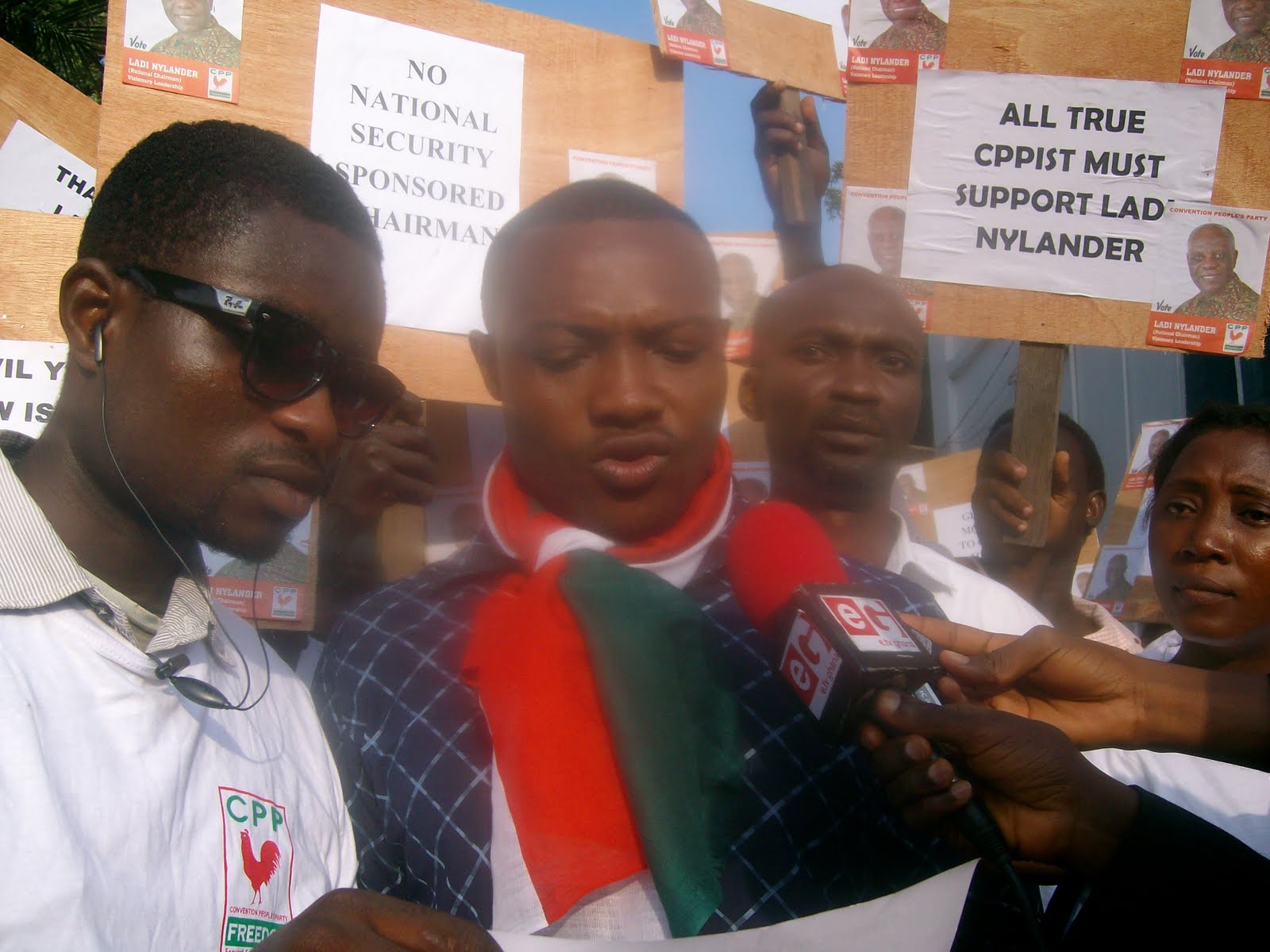
FRIENDS OF Ladi Nylander (FOLAN), a youth grouping of the Convention Peoples’ Party (CPP) has taken issue with what it sees as negative campaigning by some executives of the party against the national chairman.
The group registered their displeasure about the situation with a march to the CPP headquarters amidst songs and the hoisting of placards to present a petition advocating a second term for Ladi Nylander.
According to the group, unconstructive campaigning with harsh words targeted at the chairman was disturbing the party’s progress.
“We find it difficult to understand why some party members do not see eye to eye with the chairman looking at the pragmatic steps the chairman is taking to push the party ahead.”
It therefore called on the executives to come together to give their support to the incumbent in order for him “to finish the good things that he has started.”
“The CPP has been changing chairpersons every four years and this is not helping the party at all,” they said.
Giving reasons for the call at a press briefing in Accra, Emmanuel Nii Odoi, CPP 2008 parliamentary candidate for Odododiodo constituency said the party has seen some good innovative initiatives since the tenure of Nylander as chairman.
“These include the introduction of a shadow cabinet, family dialogue and inclusiveness of all persons in the central committee,” he explained.
Nii Odoi stated that people support different candidates for different reasons; however supporting a candidate should be through active campaigning and not destruction of an opponent’s image in order to make one’s candidate popular.
“People with genuine grievances within the party should take advantage and channel their complaints through the appropriate internal mechanisms for amicable resolution and not in the media just to destroy the image of the party.”
Past experiences during internal elections have showed that it becomes difficult for the party to unite afterwards to compete for the national elections, he said.
“We therefore want to ask that the incumbent chairman be allowed to exhibit the experience he has painstakingly acquired over the past few years that he has been chairman,” concluded Nii Odoi.

Caption: Emmanuel Nii Odoi (middle) speaking to the press at the event
Fire Guts Ridge Hospital ®
By Jamila Akweley Okertchiri
PERSONNEL of the Ghana National Fire Service (GNFS) lived up to expectation yesterday as they were able to halt a fire which broke out at a section of the emergency quarters for staff of the Ridge Hospital in Accra.


Although no casualties were recorded, the fire destroyed 75 percent of items and other equipment in the affected rooms including GH¢1,018.
An eyewitness, Isaac Acquaye who could not tell what caused the fire said it started about 11:15am from the first room of the block which is occupied by the night superintendent.


“The moment I saw smoke coming from the quarters, I together with two others got some sachets of pure water to quench it but we could not,” he said.
Acquaye said in their bid to stop the fire from spreading to the adjoining rooms on the block, they decided to call in the fire service personnel.
Sillim Sayers, Health Service Administrator at the hospital and an eyewitness also said the fire destroyed everything in the first room but some items including hospital documents, books, water, mattresses, furniture and the television were savaged by staff from the other rooms.

Regional Fire Commander at Makola, Edwin Ekow Blankson, briefing the press said the service arrived at the scene within five minutes after receiving a call about a fire outbreak at the Ridge Hospital around 11:30am.
He told DAILY GUIDE the building was still intact as fire personnel were able to contain the fire within twenty minutes. “There is no way the fire could move beyond the set boundary,” he added.
He was unable to establish the cause of the fire and or the extent of damage immediately, adding that a committee will be set up to investigate the incident.
Dr. Obeng Apori, Medical Director of Ridge Hospital commended the fire service for their swift response to the distress call.
“If it had not been for the swift intervention of the fire service, the situation would have been very disastrous.”
He later called on government to refurbish the hospital in order to avoid a recurrence of the event.
RAMADAM DATE ANNOUNCED
BY JAMILA AKWELEY OKERTCHIRI
The National Chief Imam, Sheikh Osman Nuhu Sharubutu, has announced the date for the observation of the crescent to signal the commencement of this year’s Ramadan.
Briefing the press on the start of the Ramadan, the National Executive Secretary at the office of the National Chief Imam, Alhaji Awaisi Bio, said 31st July 2011 shall be the first day for the observation.
If the crescent is not sighted on the said day, Monday, August 1, 2011 shall complete the month of Sha’ban by calculation.
“Consequently, Tuesday, the 2nd of August 2011 shall be an automatic day for the commencement of the fast for the year 2011,” he said.
Alhaji Bio therefore called on Muslims to bury their differences and unite to develop the country.
Sheikh Osman Nuhu Sharubutu commented, “The people of Sodom and Gomorrah were destroyed because of the practice of homosexuality and that even foreigners who were there were all punished by Allah Almighty.”
He added that Allah created male and female for the purpose of procreation, noting, “If Allah wanted us to practice this, He wouldn’t have created a woman when Adam wanted a partner in the Garden of Eden’.
Sheikh Nuhu Sharubutu therefore called on Ghanaians to frown on the act in order to avoid incurring the wrath of Allah Almighty.
He also appealed to the authorities to do everything to stop the practice.


From left, Alhaji Osman Kadri, Chairman of occasion, Sheikh Osman Nuhu Sharubutu, National Chief Imam and Alhaji Abdul Kadri Tabir, Greater Accra chief of Dagomba and vice chair of the council of Muslim chiefs.
Hugs for Ghana Donates to Hospitals®
By Jamila Akweley Okertchiri

HUGS FOR Ghana, a student-led nonprofit organization in Mukilteo, USA has donated 100 sets of thermometers to four hospitals in the Greater Accra and Western regions of Ghana.
Korle Bu Children’s Hospital, Princess Marie Children’s Hospital, Labadi General Hospital and Eikwe Hospital are the beneficiaries of the items worth approximately $3,500.
The organization, founded by 16 year old Joel Bervell, is dedicated to supporting underprivileged children in hospitals, institutions and other child-related services in Ghana.
Presenting the items to Rebecca Lartey, Deputy Director of Nursing Services, Bervell, President of the organization said, “The organization’s mission is to reveal the gift of love, hope, confidence and warmth to the hearts and lives of Ghana’s youngest citizens.”
He said funds for the donation were raised through the health initiative projects-‘100 Cents Saves a Life’ and ‘Ghanaian Night of Culture,’ both free will donation events.
“The focus of the fundraiser was to provide information to the community about the needs of disadvantaged children in Ghana,” added Bervell.
He hoped the thermometers would contribute to the path of healing for children while at hospitals.
Mrs. Lartey said the donation had come at a time when the hospital needed it the most. She expressed joy about the donation and called on others to follow in the footsteps of Hugs for Ghana.


Joel Bervell presenting a thermometer to Mrs. Rebecca Lartey at the Korle Bu Children’s Hospital.